This time we are not as concerned about the timing (though it is significant in many cases) but rather about the amusement level of the photos. So enjoy the pics!
Monday, April 12, 2010
Sunday, April 11, 2010
World's Largest Fully Steerable Radio Telescope
The Robert C. Byrd Green Bank Telescope is the world's largest fully steerable radio telescope. The Green Bank Telescope (GBT) is located at the National Radio Astronomy Observatory's site in Green Bank, Pocahontas County, West Virginia (79° 50' 23.40" W, 38° 25' 59.23" N : NAD83).
The GBT is described as a 100-meter telescope, but the actual dimensions of the surface are 100 by 110 meters. The overall structure of the GBT is a wheel-and-track design that allows the telescope to view the entire sky above 5 degrees elevation. The track, 64 m (210 ft) in diameter, is level to within a few thousandths of an inch in order to provide precise pointing of the structure while bearing 7300 metric tons (16,000,000 pounds) of moving weight.
Saturday, April 10, 2010
World's Largest Single-Aperture Radio Telescope
The Arecibo Observatory is a radio telescope located close to the city of Arecibo in Puerto Rico. It is operated by Cornell University under cooperative agreement with the National Science Foundation. The observatory works as the National Astronomy and Ionosphere Center (NAIC) although both names are officially used to refer to it. NAIC more properly refers to the organization that runs both the observatory and associated offices at Cornell University.
The observatory's 305 m radio telescope is the largest single-aperture telescope (cf. multiple aperture telescope) ever constructed. It carries out three major areas of research: radio astronomy, aeronomy (using both the 305 m telescope and the observatory's lidar facility), and radar astronomy observations of solar system objects. Usage of the telescope is gained by submitting proposals to the observatory, which are evaluated by an independent board of referees.
The telescope is visually distinctive and has been used in the filming of notable motion picture and television productions: as the villain's antenna in the James Bond movie GoldenEye, as itself in the film Contact, the The X-Files episode "Little Green Men", and the docu-drama Super Comet: After The Impact. The telescope received additional international recognition in 1999 when it began to collect data for the SETI@home project.
A detailed view of the beam-steering mechanism and some antennas. The triangular platform at the top is fixed, and the azimuth arm rotates beneath it. To the left is the Gregorian sub-reflector, and to the right is the 96-foot long line feed tuned to 430 MHz. Just visible at the upper right is part of the rectangular waveguide that brings the 2.5 MW 430 MHz radar transmitter's signal up to the focal region.
Design and architecture
The construction of the Arecibo telescope was initiated in the summer of 1960 and completed in November, 1963, by Professor William E. Gordon of Cornell University, who originally intended to use it for the study of Earth's ionosphere.Originally, a fixed parabolic reflector was envisioned, pointing in a fixed direction with a 150 m (500 ft) tower to hold equipment at the focus. This design would have had a very limited use for other potential areas of research, such as planetary science and radio astronomy, which require the ability to point at different positions in the sky and to track those positions for an extended period as Earth rotates. Ward Low of the Advanced Research Projects Agency (ARPA) pointed out this flaw, and put Gordon in touch with the Air Force Cambridge Research Laboratory (AFCRL) in Boston, Massachusetts where a group headed by Phil Blacksmith was working on spherical reflectors and another group was studying the propagation of radio waves in and through the upper atmosphere. Cornell University proposed the project to ARPA in the summer of 1958 and a contract was signed between the AFCRL and the University in November 1959. Cornell University published a request for proposals (RFP) asking for a design to support a feed moving along a spherical surface 435 feet (133 m) above the stationary reflector. The RFP suggested a tripod or a tower in the center to support the feed.
George Doundoulakis, director of research for the antenna design company General Bronze Corp in Garden City, N.Y. received the RFP from Cornell and studied it with his brother, Helias Doundoulakis, a civil engineer. The brothers devised a more efficient way to suspend the feed, and finally designed the cable suspension system that was used in final construction. The U.S. Patent office granted Helias Doundoulakis a patent on this approach.
Construction began in the summer of 1960, with the official opening on November 1, 1963.[11] As the primary dish is spherical, its focus is along a line rather than at a single point (as would be the case for a parabolic reflector), thus complicated 'line feeds' had to be used to carry out observations. Each line feed covered a narrow frequency band (2-5% of the center frequency of the band) and a limited number of line feeds could be used at any one time, limiting the flexibility of the telescope.
The telescope has undergone significant upgrades. Initially, when the maximum expected operating frequency was about 500 MHz, the surface consisted of half-inch galvanized wire mesh laid directly on the support cables. In 1974, a high precision surface consisting of thousands of individually adjustable aluminum panels replaced the old wire mesh, and the highest usable frequency was raised to about 5000 MHz. A Gregorian reflector system was installed in 1997, incorporating secondary and tertiary reflectors to focus radio waves at a single point. This allowed the installation of a suite of receivers, covering the whole 1–10 GHz range, that could be easily moved onto the focal point, giving Arecibo a new flexibility. At the same time, a ground screen was installed around the perimeter to block the ground's thermal radiation from reaching the feed antennas, and a more powerful 2400 MHz transmitter was installed.
Topless on The Streets of New York
This original photographic essay by Jordan Matter takes us to the streets of New York, where he photographed topless women.
Friday, April 9, 2010
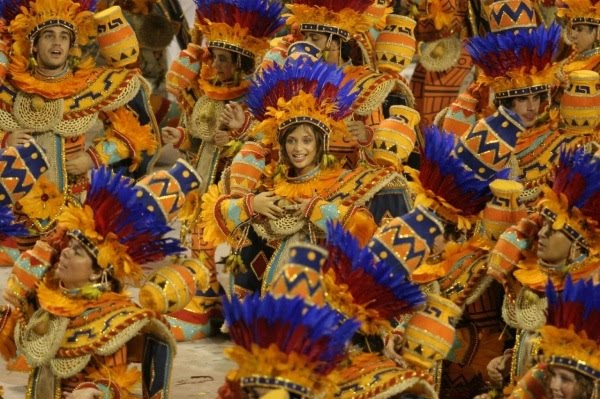
Rio de Janeiro's Carnival
Although carnival is celebrated in thousands of cities around the globe, Rio de Janeiro has become the eternal capital of carnival in the world. Carnival in Rio is not only the biggest, it also serves as a standard for every other celebration to be compared with and show its greatness. Everyone, in any part of the world, has heard of carnival in Rio, an annual event that moves over half a million tourists that flock to Brazil to witness this crazy happening.
This event is a four-day celebration. It officially starts on a Saturday and ends on a Tuesday. Carnival, with all its excesses is celebrated in February, the hottest month is the southern hemisphere, at the peak of summer. Whether it's because of the weather or not, the festive atmosphere is unlike any other, where you can see dancing and bodies with little clothing, in a climate of unique human closeness. This is, in fact, the biggest cultural event in Brazil, incredibly well-known and broadcast around the world.
With this event approaching, here are a few pictures to open your appetite and, who knows, convince a few Europeans to take the trip of a lifetime. One last note to the colourful pictures by Carlos Morel. Refferences at the bottom of the article.
Thursday, April 8, 2010
Top Weirdest CIA Programs
Over the years, the American Central Intelligence Agency has gained a reputation for being the most far-reaching, sophisticated, and effective government intelligence agency on the planet. At the same time, the CIA has also become known for its incredible paranoia and propensity to undertake costly, sometimes illegal, and often downright absurd projects in the name of gaining an edge on the competition. From spy cats to psychic hippies, the following are ten of the weirdest spy programs the government has proposed and funded over the years.
10. Acoustic Kitty
10. Acoustic Kitty
Most people wouldn’t think of the common house cat as being a potential master of espionage, but the CIA sure did. In the 1960s, American intelligence is said to have spent over $20 million on “Acoustic Kitty,” a top-secret project that used cats as recording devices. The project took a group of specially trained cats and surgically implanted microphones, antennae and batteries into their tails, and then set them loose near the Russian embassy. The idea was that an unassuming cat would be able to stride right up to groups of communist officials and listen in on their conversation, which it could then beam back to agents with its sophisticated radio equipment. The plan was eventually put into action, but the first cat sent into the field was supposedly run over by a taxi before it could make a recording, and operation ‘Acoustic Kitty” was abandoned shortly thereafter.
9. Operation Mockingbird
One of the most ambitious and downright insidious programs ever launched by the CIA was Operation Mockingbird, a propaganda project that was implemented in the early 1950s. It was a massive undertaking that saw as many as 3,000 CIA agents and collaborators attempt to gain some control of the free press by feeding select groups of reporters information and using newspapers at home and abroad to filter the kinds of stories that got to the public. At its height, the program included writers for the New York Times, Newsweek, and Time Magazine among its ranks, and was said to have a significant influence on as many as 25 major newspapers. The program had a major impact abroad, as well, as it served a major function in helping to sway public opinion in the run-up to the eventual overthrowing of Guatemala’s leftist president. Operation Mockingbird continued to have a major effect on worldwide media throughout the 50s, and it was not until the 60s that a series of reports by investigative journalists brought the program to light.
8. Operation Gold
8. Operation Gold
One of the most audacious intelligence operations of the Cold War was 1953’s Operation Gold, which was a joint effort between the CIA and the British MI6 to hack into the phone lines of the Soviet headquarters in East Berlin. This required the construction of a massive 450-meter long tunnel that would intersect with an underground telephone junction. Just preparing the tunnel took six months, and involved a substantial amount of risk and subterfuge. But when it was done, the CIA proceeded to carefully record as many as 50,000 telephone conversations over the course of nearly a year. The problem? A mole in British intelligence had tipped off the KGB about Operation Gold before the tunnel was even completed, and the Soviets had been feeding fake them information the entire time. In 1956, the Soviets raided the tunnel and shut it down, and the operation eventually caused a great deal of controversy for the American and British intelligence communities.
7. Operation Northwoods
In the early 1960s, when the Cold War was in full swing and fear of communism was rampant, a plan dubbed Operation Northwoods was proposed within the American CIA. In short, it called for the government to perform a series of violent terrorist actions in U.S. cities including bombings, hijackings, phony riots, and sabotage, all of which could then be blamed on Cuba. This would drum up support for a war against the communists and lead to an eventual military operation to remove Fidel Castro from power. The plan was drafted and signed by the Joint Chiefs of Staff and presented to President John F. Kennedy, who personally rejected it, and it was subsequently abandoned. For years after, Operation Northwoods existed as a rumor, but it was finally revealed to be true when top-secret documents describing the plan were made public in 1997 as part of a release of government papers relating to the Kennedy assassination.
6. Project Pigeon
6. Project Pigeon
One of the most seemingly preposterous military programs of all time occurred during WWII, when famed behavioral psychologist B.F. Skinner was enlisted by the government to try and train pigeons for use in a missile guidance system. At the time, Skinner was known as one of the major practitioners of operant conditioning, a system that used reward and punishment as a means of controlling behavior. With these ideas in mind, Skinner placed a series of specially trained pigeons inside missiles. A camera on the front of the missile recorded its flight path, which was then projected on a screen for the pigeon to see. The birds were trained to recognize the missile’s intended target, and they would peck at the screen if it was drifting off course. This information was fed to the weapon’s flight controls, which would then be changed to reflect the new coordinates. Skinner was originally given $25,000 to get the project up and running, and he actually managed to make some minor progress with it. But government officials were never quite able to get past the obvious absurdity of the program, and it was eventually shut down. Image credit: http://www.psywarrior.com/
5. Operation Midnight Climax
In the early 1960s, the youth culture of America was first beginning to experiment with hallucinogenic drugs like LSD, and so was the Central Intelligence Agency. Operation Midnight Climax was one of the government’s most ridiculous and illegal attempts to test the possible uses of drugs like acid by administering them to unsuspecting citizens. The program was run out of a collection of safehouses in New York and California. Prostitutes were used to lure young men to the houses, at which point they were given food or drink spiked with LSD and other drugs and placed in a room with a two-way mirror where their behavior could be observed. Midnight Climax was essentially an experimental program designed to monitor the possible tactical uses of psychotropic drugs and sexual blackmail in the field, but even within the Agency it was controversial, and it was shut down after only a few years. Most of the files connected to the operation were destroyed, but a few survived, and in the early 70s the files regarding Midnight Climax and many other illegal CIA programs were brought to light in a famous story by the New York Times.
4. The Stargate Project
The $20 million Stargate Project was a blanket term used to describe a large number of psychic experiments and investigations undertaken by the U.S. government between the 70s and 90s. The biggest goal of the Stargate Project was to investigate the scientific probability of “remote viewing,” which is the psychic ability to witness events over great distances. The program, which also investigated psychic abilities like out of body experiences and clairvoyance, tested subjects on their ability to predict future events and read hidden documents. The Stargate Project usually enlisted the services of anywhere from 3 to 22 subjects at a time, many of whom managed to test with an accuracy rating as much as 15% higher than the norm. Still, although some participants claimed to have correctly predicted major world events like military attacks and hostage situations, the program found that remote viewers and so-called telepaths were still wrong nearly 80 percent of the time, and in 1995 the CIA cancelled the Stargate Project for good.
3. Operation Mongoose
2. Project MKULTRA
One of the most downright creepy government programs and the fodder for countless conspiracy theories, Project MKULTRA was a sweeping and top-secret CIA program started in the early 1950s that included experiments in “chemical interrogation” and mind control. In short, MKULTRA was a plan that sought to use drugs, psychological stress, and bizarre interrogation methods to get information, control behavior, and even alter brain function. To this day, much of the information on the project remains classified, but what we do know is that the program involved the testing and interrogation of private citizens—often without their knowledge or consent—in the service of discovering whether or not certain drugs could be used as truth serums. This included giving subjects large doses of LSD, amphetamine, and mescaline, as well as shock therapy. In one case, subjects were supposedly dosed with acid for 77 days straight in an attempt to test the effects of long-term exposure to the drug. Conspiracy theories abound about the real goals of the project, with some saying it was a program to engineer zombie assassins through mind control and brainwashing. Some information about MKULTRA was finally brought to light in the early seventies, when news reports about CIA abuses of power led to a Congressional commission. The project was subsequently shut down, but many people claim that similar CIA programs still exist to this day.
1. The Bay of Pigs Invasion
For sheer absurdity, wastefulness, and infamy, few CIA projects compare to 1961’s failed Bay of Pigs Invasion. The program was one of the first and boldest attempts to overthrow communist Cuban leader Fidel Castro, but it was also the most disastrously unsuccessful. It started in 1960, when the CIA, under the authorization of the President, began planning an attempted overthrow of the Cuban government. In order to eliminate any link to the U.S., the attack was to be perpetrated by an army of Cuban exiles specially trained by the CIA. After a series of diversionary air strikes, on April 17, 1961, a group of amphibious troop transports landed on a beach in the Bay of Pigs and began unloading their cargo of 1,300 exile guerillas. The plan was for them to rendezvous with a smaller band of paratroops to be dropped soon after their arrival, but from the beginning their plan was tragically mistimed. For starters, Cuban intelligence was already aware of the planned invasion, and this meant that when the exile troops landed they were almost immediately under attack. To add to the force’s problems, bad weather, coral reefs, and the Cuban swamps quickly claimed most of their equipment. All told, an estimated 2,000 Cubans died during the invasion, while over 100 members of the exile army were killed in action. The remaining 1,200 were captured and imprisoned, and some were later executed on the orders of Castro. Over a year later, the rest were freed in exchange for $53 million in food and medicine for Cuban people. The effects of the Bay of Pigs were far reaching. Several American officials resigned over their involvement in it, and many have credited it with increasing the resolve of the Cuban government and encouraging a severe distrust of American foreign policy in the years that followed.
Wednesday, April 7, 2010
Most Controversial Magazine Covers
10. Wired (June 1997)
iPray
I personally bought this issue of Wired, being a huge Apple fan, and still have it to this day. The graphical power of this cover is amazing and the desperation of Apple is evident. If you were a computer owner, PC or Apple, this cover was of interest. Depicting the impending death of the biggest brand on the planet, at the time, was bound to stir up trouble. The article inside, “101 Ways to Save Apple,” is great reading especially now that Apple is dominating the creative/tech landscape.
9. Entertainment Weekly (May 2, 2003)

Three Chicks in Trouble
Being naked on the cover is nothing new these days but The Dixie Chicks appear naked on this cover of Entertainment Weekly with tattoos that read “Boycott,” “Traitors,” “Dixie Sluts” and “Proud Americans” on their bodies. This was on the heels of Dixie Chick member Natalie Maines criticisms of the impending invasion of Iraq by America. Some Americans boycotted The Dixie Chicks music and concerts for months even after this issue allowed them to further speak their mind
8. TIME (April 8, 1966)
Rumors of My Death
Any time someone questions God you are going to get controversy and this Time magazine cover from April 8, 1966 was no exception. This was the first time the magazine used an all type cover, but the question “Is God Dead?” was the bigger issue and the article inside which preached the “death of God” inflamed readers.
7. TIME (January 2, 1939)
For Better or Worse
On January 2, 1939, Time Magazine published its annual Man of the Year issue. For the year 1938, Time had chosen Adolf Hitler as the man who “for better or worse” had most influenced events of the preceding year. The cover picture featured Hitler playing “his hymn of hate in a desecrated cathedral while victims dangle on a St. Catherine’s wheel and the Nazi hierarchy looks on.”
6. Babytalk (August, 2006)
The Breast of Ideas
Readers of the August 2006 US parenting magazine, Babytalk were up in arms over the publication’s cover depicting a woman breastfeeding, with many calling the photo offensive and disgusting. The whole point of the cover was to bring focus to the controversy surrounding breastfeeding in the United States, where a survey found that 57 percent were opposed to women breastfeeding in public.
5. Vogue (April, 2008)
Twas Beauty That Killed The Beast
One of the more recent covers to illicit controversy was the Vogue cover with basketball superstar LeBron James who shares the April cover of the magazine with supermodel Gisele Bundchen. The controversy stems from the opinion that his screaming face and cradling of a blond woman has racial overtones in its resemblance to the movie poster of King Kong and Fay Wray.
4. Art Monthly (July, 2008)
In the Eyes of the Beholder…
Art Monthly, Australia magazine sparked outrage over naked images of children by publishing an image of a six-year-old Olympia Nelson on its July cover and two shots inside. The magazine’s editors said the images were chosen as a protest against an uproar over similar pictures by artist Bill Henson. The shot of Olympia was taken in 2003 by her mother, Melbourne photographer Polixeni Papapetrou.
I have blurred portions of the photo as not to offend any readers. You can see the unedited version on the Art Monthly site.
3. Playboy (October 1971)
Black and White
While many Playboy covers can be considered controversial, this cover makes the list for breaking the color barrier which features an African-American on the cover for the first time. Darine Stern sits in a Playboy bunny chair on this October 1971 Playboy cover.
2. Golfweek (January, 2008)
While many Playboy covers can be considered controversial, this cover makes the list for breaking the color barrier which features an African-American on the cover for the first time. Darine Stern sits in a Playboy bunny chair on this October 1971 Playboy cover.
2. Golfweek (January, 2008)
Controversy becomes Controversy
Even in today’s more enlightened age Golfweek pushed the envelope a little too far. On Jan. 19, 2008 Golfweek magazine chose the image of noose to illustrate a story about a TV anchor’s racially tinged comments, but the graphically powerful photo of a noose became a controversy all its own. The editor was fired after a public backlash of negative comments.
1. Esquire (April 1968)
Ouch, Standing Up for Beliefs Can Hurt
When it comes to controversial covers it helps to start with a controversial personality and Muhammad Ali was never one to hold his tongue or his opinions. In this April 1968 Esquire magazine cover, “The Greatest Of All Time” is depicted as the martyred Saint Sebastian, patron saint of athletes. St. Sebastian was pierced with arrows for his religious beliefs. Ali is similarly pierced by six arrows, as Esquire defended his refusal to be drafted into the U.S. Army because of his own religious beliefs. He was convicted of violating the Selective Service Act and stripped of his title.
Honorable Mention
TIME (April 14, 1997)
Coming Out…Again
Yep, she is gay and this cover came out and stated as much. Time magazine featured Ellen DeGeneres with the words, “Yep, I’m Gay” in bright red bold letters as part of Ellen’s coming out party, making her television’s first openly gay star. The television character played by DeGeneres on Ellen came out later that month. Coming out twice is quite the feat, and doubly controversial.
Subscribe to:
Posts (Atom)